Hoop Notes...
Basketball thoughts are gathered, borrowed, mis-quoted, compiled and then shared...that's my goal here...
Details and Little Things
We’re down 2 with 12 seconds left in the conference championship. Sideline out of bounds. We call a timeout.
In this moment, every detail matters. Who do you trust to make the inbound pass? Who do you trust to set a solid screen so your point guard can get open? Who do you trust to execute the play exactly as it’s drawn up? That’s a lot of trust—and it doesn’t appear overnight. It’s built over the course of a season, in all the small details and little habits.
It’s not always the best athlete, the best ballhandler, or the best shooter who gets trusted in crunch time. Coaches remember who consistently does the little things. When a coach says “two lines on the elbows” and half the team hangs around the three-point line, who is listening? Subconsciously, that trust gets built—or lost—right there. The players who sprint to the right spots in practice are often the ones a coach leans on in the final minute of a game.
That’s why coaches add constraints in practice—like dribble limits, pass minimums, or cones you must go around. It’s not about the cone. It’s about seeing who can follow through, who can be relied on, who is trustworthy when the pressure is highest.
Coaches aren’t supposed to have favorites, right? Wrong. Their favorites aren’t based on talent—they’re based on trust. Coaches favor the kids who go around the cones, jump to the front of lines, listen intently, communicate on defense, smile, and compete.
Pete Carril, the Hall of Fame coach from Princeton, called them “Lightbulbs.” Lightbulbs brighten a room. They lift teammates. They fill a coach’s tank. And when the game is on the line, those are the players a coach wants on the floor.
We’re down 2 with 12 seconds left in the conference championship. Sideline out of bounds. We call a timeout.
In this moment, every detail matters. Who do you trust to make the inbound pass? Who do you trust to set a solid screen so your point guard can get open? Who do you trust to execute the play exactly as it’s drawn up? That’s a lot of trust—and it doesn’t appear overnight. It’s built over the course of a season, in all the small details and little habits.
It’s not always the best athlete, the best ballhandler, or the best shooter who gets trusted in crunch time. Coaches remember who consistently does the little things. When a coach says “two lines on the elbows” and half the team hangs around the three-point line, who is listening? Subconsciously, that trust gets built—or lost—right there. The players who sprint to the right spots in practice are often the ones a coach leans on in the final minute of a game.
That’s why coaches add constraints in practice—like dribble limits, pass minimums, or cones you must go around. It’s not about the cone. It’s about seeing who can follow through, who can be relied on, who is trustworthy when the pressure is highest.
Coaches aren’t supposed to have favorites, right? Wrong. Their favorites aren’t based on talent—they’re based on trust. Coaches favor the kids who go around the cones, jump to the front of lines, listen intently, communicate on defense, smile, and compete.
Pete Carril, the Hall of Fame coach from Princeton, called them “Lightbulbs.” Lightbulbs brighten a room. They lift teammates. They fill a coach’s tank. And when the game is on the line, those are the players a coach wants on the floor.
|
Practice Checklist
Your browser does not support viewing this document. Click here to download the document.
|
Constraint Lead Approach
Be creative! Simply put, create some constraints, such as limiting dribbles, a certain # of passes before a shot, the ball must touch paint before a shot, every score must be off 2 feet, etc...These concepts mentally keep you engaged and thinking! As your creativity expands, you can shrink the floor, play 2v2 in 1/4 court and you must start with the ball in your left hand, etc.. Eventually the players figure things out and learn how to use their talents. Developing IQ
Players need to be in situations where decisions are made. Drills are important for so many reasons and there is no substitute for repetitions! I hear so much that Basketball IQ is at an all-time low. "Kids don't know how to play." Decisions need to be made in all training situations. Teach the Decisions not the results! 2v1, 3v2, disadvantage drills, 1v1 with reads, decision shooting training (Chris Oliver), etc...These are the things that lead to a higher IQ. We play a ton of 3v3 out of some kind of "disadvantage". It allows you to teach reading defense, getting your players shots, moving off post feeds, defensive communication. It is OK for players to fail, allow them to figure things out on their own. If they figure out things on their own habits will stick much quicker and longer! |
|
How and Why Watch Film!
This might be the most important thing you can do as a coach! It leads to proof, confidence, honesty, etc... Spend time with your team!!!
Your browser does not support viewing this document. Click here to download the document.
|
High School Late Game Situations - thought-provoking and planned out!!!
Your browser does not support viewing this document. Click here to download the document.
|
Game-like shots:
Repetition is the mother of skill development! The amount of shots you can get up while using Dr. Dish or the Gun does nothing but build confidence. All shooters need confidence to knock down big shots when needed. I think the stats claim that shot percentage goes down roughly 30% from Dr. Dish to in-game shots. How can we work on these gaps? I think shooting needs to become competitive, and it needs to be fast-paced and game-like. What shots are you getting in games, and do they match the speed/pace at which you play? It must match! Make these workouts fun and competitive to maximize the time spent!
Rebounding:
I am convinced after watching so many games at so many levels that rebounding is mostly quickness to balls. How many rebounds are actually gotten above 6 or 8 feet high. Obviously, if you are big and quick, that's a great combo and one that is very unique! I am a big box-out guy, but I am seeing more and more box-out guys that don't pursue the ball as quickly as needed. It has to be an emphasis in each practice to pursue the ball! With the amount of long three-pointers taken in the game today, there's long rebounds bouncing out to the arc. Those rebounds go to the quickest / fastest to the ball - NOT the biggest. Huge advantage if you got a big man that can chase down long rebounds, but it's the guards that need to go get them!.
Transition Defense:
1) The ball must get defended asap!
2) The ball must be forced to a side. You cannot allow the offense to get in middle 1/3 of the floor! That destroys help defense. Once ball is forced to outside 1/3 of the floor, you create a strong side and a weak side.
3) Defend the Rim - every team sends someone to front of rim.
4) Defend ballside wing
5) Flood to ball side - Last one back sprint to mid line and adjust as best you can.
***Don't worry about mismatches too much (really depending on level), but most everyone should be able to be "tough" enough to defend for a pass or two till switching can happen. How many teams are actually disciplined enough to find mismatches??
1) The ball must get defended asap!
2) The ball must be forced to a side. You cannot allow the offense to get in middle 1/3 of the floor! That destroys help defense. Once ball is forced to outside 1/3 of the floor, you create a strong side and a weak side.
3) Defend the Rim - every team sends someone to front of rim.
4) Defend ballside wing
5) Flood to ball side - Last one back sprint to mid line and adjust as best you can.
***Don't worry about mismatches too much (really depending on level), but most everyone should be able to be "tough" enough to defend for a pass or two till switching can happen. How many teams are actually disciplined enough to find mismatches??
Why you need to Push the basketball!
* Defense is the most disorganized in transition. One of the hardest things in the game is to get players to communicate (not talk, but communicate)! Why wouldn't you try to take advantage of this!
* Take advantage of what you do well... Create situations in transition that help your team. Example - you have a good ballscreen reading PG and a trail that can shoot - put them in a ballscreen and pop type action early.
* It creates another thing that teams must prepare for. If opponents need to spend time defending you in transition, that is taking away a lot of time that they spend worrying about your sets, BLOB's, SLOB's, etc.
* Allows you to play more players - Helps create team buy in and comradery. The more kids that are playing, the more parents are apt to buy in with booster clubs and money!
* Lastly, It's fun! Kids eventually will love playing up and down the floor
* Defense is the most disorganized in transition. One of the hardest things in the game is to get players to communicate (not talk, but communicate)! Why wouldn't you try to take advantage of this!
* Take advantage of what you do well... Create situations in transition that help your team. Example - you have a good ballscreen reading PG and a trail that can shoot - put them in a ballscreen and pop type action early.
* It creates another thing that teams must prepare for. If opponents need to spend time defending you in transition, that is taking away a lot of time that they spend worrying about your sets, BLOB's, SLOB's, etc.
* Allows you to play more players - Helps create team buy in and comradery. The more kids that are playing, the more parents are apt to buy in with booster clubs and money!
* Lastly, It's fun! Kids eventually will love playing up and down the floor
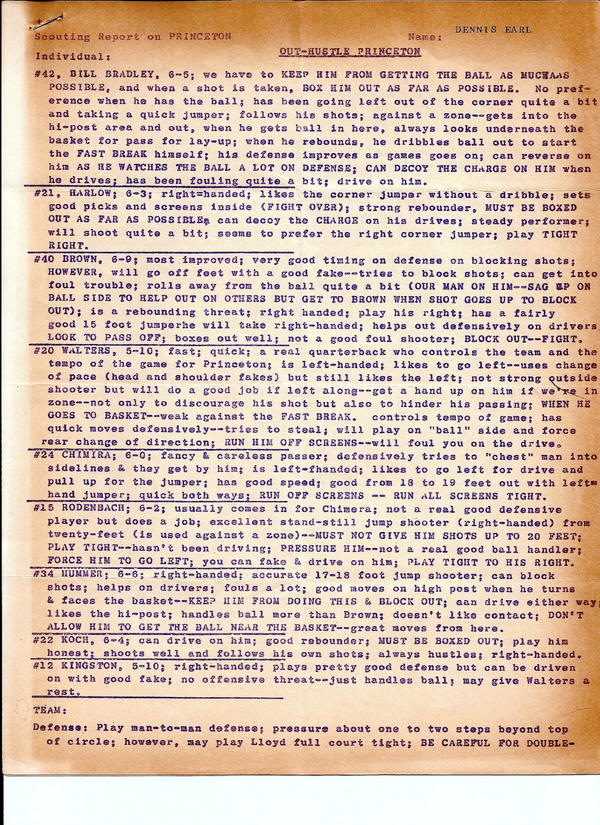
This is a scout from Rutgers University vs. Princeton University. My dad played with legendary Bill Bradley and this Princeton team went to the final four this year. Pretty cool finding things like this!
RSS Feed